
The God Horus in Egyptian Art: A Sky God's Many Faces
6 min reading time
6 min reading time
I remember the first time I saw Horus staring back at me from a museum wall. Those eyes. They looked right through me, fierce and protective at once. I wasn't sure what I was looking at then. A bird? A man? Both? The answer turned out to be more interesting than I expected.
Horus sits at the heart of Egyptian art. He shows up everywhere. Temple walls. Tomb paintings. Small statues tucked into corners. The ancient Egyptians couldn't seem to get enough of him. And when you dig into why, you start to understand their world a bit better.
Horus was a sky god. His father was Osiris, the god of the dead. His mother was Isis, who knew more magic than anyone else. The story goes that Horus fought his uncle Set to claim the throne of Egypt. He won, but he lost an eye in the battle. That eye became one of the most famous symbols in all of Egyptian culture.
Kings called themselves "Living Horus." They weren't just rulers. They were the god himself walking on earth. This wasn't a small claim. It meant every pharaoh carried divine power in his veins.
Most of the time, artists showed Horus as a falcon. Not just any bird. A peregrine falcon, sharp and fast. These birds dive at speeds that make your head spin. The Egyptians watched them hunt and saw power. They saw the sky itself made flesh.
Walk through any Egyptian collection and you'll spot falcon statues. Some are tiny, small enough to fit in your palm. Others stand taller than a grown person. The artists gave them smooth lines and proud poses. Wings tucked close. Heads held high. Eyes that seem to follow you across the room.
I've stood in front of these statues and felt small. That's the point, I think. Horus was meant to inspire awe.
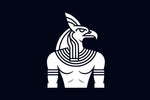
Here's where things get strange. Egyptian artists didn't just pick one form for Horus. They mixed human and animal together. A man's body. A falcon's head. It sounds odd when you first hear about it. But when you see it in person, it works.
These hybrid images fill temple walls from one end of Egypt to the other. Horus stands tall, usually holding a staff or an ankh. Sometimes he wears the double crown of Upper and Lower Egypt. The falcon head sits perfectly on human shoulders. It doesn't look wrong. It looks powerful.
The artists knew what they were doing. They wanted to show that Horus existed between worlds. Not quite human. Not quite animal. Something greater than both.
That eye I mentioned earlier? It became its own symbol. The Eye of Horus, or the wedjat eye, pops up in Egyptian art constantly. It's not a regular eye. It has markings underneath that look like the facial patterns of a falcon.
People wore it as jewelry. Artists carved it into amulets. It meant protection, healing, and wholeness. When Horus lost his eye fighting Set, the god Thoth healed it. The restored eye became a sign that broken things could be made whole again.
I find this idea comforting. The Egyptians didn't shy away from loss. They just believed in repair.
Egyptian artists picked their colors with care. Horus often appears in gold, the color of the sun and divine flesh. Blue shows up too, linking him to the sky. Sometimes you see green, the color of life and growth.
The materials mattered just as much. Bronze statues. Limestone carvings. Painted wood. Precious metals for the wealthy. Cheaper stuff for regular people. Everyone wanted a piece of Horus, no matter their budget.
Gold leaf caught the light in temple sanctuaries. When priests carried torches past these images, Horus would seem to glow. The effect must have been stunning. Divine presence made visible.
Artists loved showing Horus with kings. He stands behind the pharaoh, wings spread in protection. Or he presents the ankh to the ruler's nose, giving him the breath of life. These images told a clear story: the king ruled with divine backing.
But there's something vulnerable in these scenes too. The pharaoh needed Horus. He couldn't rule alone. Even the most powerful person in Egypt required help from the gods. That admission of need strikes me as honest.
The confusion deepens when you learn there were many forms of Horus. Horus the Elder. Horus the Younger. Horus of Behdet. Haroeris. Harpocrates. Each had special traits. Each appeared differently in art.
Sometimes Horus looks like a child. Artists showed him as a young boy, often with a finger to his lips. This represented the sun at dawn, young and fresh. Other times he's a warrior in his prime, fierce and battle-ready.
I used to find this frustrating. Why couldn't they pick one version and stick with it? Now I see it differently. The Egyptians understood that divine beings couldn't be pinned down to single forms. Gods were bigger than that. They contained contradictions.
Horus images traveled beyond Egypt. Greeks and Romans adopted him. They mixed him with their own gods. His falcon form appeared on coins and in distant temples. The symbol spread, but something got lost in translation. The deep Egyptian meaning faded a bit with each copy.
Still, that spread says something. People across cultures responded to Horus. Maybe the falcon's strength spoke to something universal. Or maybe the idea of divine protection never goes out of style.
Today, Horus stares at us from museum displays. His images show up in books, documentaries, and tourist shops. Some of the meaning has drained away. We don't worship him anymore. We don't see pharaohs as living gods.
But the art remains powerful. Those falcon eyes still grab your attention. The careful craft of ancient artists still impresses. When I look at these images now, I see people trying to capture something beyond words. They used stone and paint and gold to point toward the divine.
That effort moves me. The Egyptians believed in things they couldn't fully explain. So they made art instead. And thousands of years later, we're still looking at what they created, still trying to understand.
Horus keeps watching. The sky god with the falcon's eyes. Protector of kings. Symbol of power and healing. He won't look away.


$29.99


$44.99 - $49.99


$24.99 - $29.99


$44.99 - $49.99