
The God Who Guards the Dead: Understanding Anubis
5 min reading time
5 min reading time
I still remember the first time I saw Anubis in a museum. That black jackal head stopped me cold. Something about him felt different from the other Egyptian gods. Less distant. More real.
He scared me a bit. But I also wanted to know more.
Anubis stands as one of Egypt's oldest gods. People worshiped him for thousands of years. His image appears in tombs that date back over 5,000 years. That's older than the pyramids themselves.
Think about that for a second. Longer than most countries have existed.
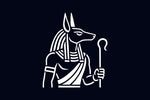
Anubis has the head of a jackal and the body of a man. His skin is black. Not brown like real jackals. Black like the fertile soil along the Nile River.
Why a jackal? The ancient Egyptians were practical people. They noticed jackals hanging around burial sites in the desert. These wild dogs would dig up shallow graves looking for food. So the Egyptians made a god who could control these animals. If you can't beat them, make them sacred.
Smart move, honestly.
The black skin holds meaning too. It represents rebirth and new life. The Nile's black mud brought crops every year. Death wasn't the end in Egyptian belief. It was just another beginning.
Anubis had one main job. He protected the dead and guided them to the afterlife.
When someone died in ancient Egypt, priests wearing Anubis masks performed the burial rites. They would mummify the body. This process took 70 days. Every step mattered. Every prayer counted.
The priests removed the organs. They dried the body with salt. They wrapped it in linen strips. Anubis watched over every moment.
I find this detail haunting. Imagine being a priest in that mask. The weight of it. The responsibility. You're literally becoming a god to help someone make their final journey.
Here's where things get really interesting. And a bit terrifying.
Anubis ran the most important test a soul could face. The weighing of the heart ceremony.
Picture this scene. You've just died. You stand in a great hall. Anubis leads you forward. In the center sits a giant scale. On one side, he places your heart. On the other side, a feather.
Just a feather. The feather of Ma'at, goddess of truth and justice.
Your heart had to be lighter than that feather. If you lived a good life, told the truth, treated people well, your heart would be light. You could pass into paradise. The Field of Reeds waited for you. A perfect version of Egypt where crops never failed and the sun always shone.
But if your heart was heavy with lies and cruelty? A monster named Ammit waited nearby. Part crocodile, part lion, part hippo. She would devour your heart. You would cease to exist. No afterlife. No second chances. Just nothing.
The Egyptians called this the Second Death. Worse than dying the first time.
Can you imagine that pressure? Your entire existence depending on one moment. One measurement. And Anubis holding the scales, making sure everything was fair and accurate.
People often think Anubis only cared about dead people. That's not quite right.
He also protected embalmers. The people who prepared bodies. Dangerous work in the desert heat. These workers prayed to Anubis for steady hands and clear minds.
He watched over orphans too. Children without parents fell under his care. Death takes parents sometimes. Anubis understood loss better than anyone.
Some texts show him as a healer. He knew the secrets of the body from all that embalming work. He could put people back together. Fix what was broken.
This side of him makes me see Anubis differently. He's not just grim and scary. He cares. He protects the vulnerable.
Anubis had a complicated family situation. Like most Egyptian gods, honestly.
His parents were Osiris and Nephthys. But it gets messy. Nephthys was actually married to Set, the god of chaos and deserts. She disguised herself as Isis (Osiris's wife) to sleep with Osiris.
Yeah. Egyptian mythology doesn't mess around.
When Set killed Osiris and scattered his body across Egypt, young Anubis helped Isis find the pieces. He used his skills to put Osiris back together. This made him the first embalmer. The original master of the craft.
That story always hits me hard. A son saving his father. Using knowledge and care to defeat death itself. Even if just for a moment.
You might think Anubis belongs in dusty museums. But he's still around. I see him everywhere.
Tattoos of Anubis rank among the most popular Egyptian designs. People wear him as protection. As a reminder that death comes for everyone. Better to live well now.
Video games feature him. Books reference him. Movies bring him to life with special effects.
Why does he endure? I think it's because he represents something we all face. Death. Loss. The fear of what comes next.
Anubis doesn't promise to prevent death. He can't do that. Nobody can. But he offers something else. Guidance. Protection. A fair chance at what lies beyond.
That honesty appeals to people. He doesn't lie. He doesn't sugar-coat. He just does his job with care and precision.
The ancient Egyptians built a whole religion around preparing for death. Seems morbid at first. But maybe they were onto something.
If you knew your heart would be weighed one day, how would you live? Would you lie less? Help more? Treat people better?
Anubis makes us think about our choices. Every action adds weight to our hearts. Every kindness might make us lighter.
I'm not saying the weighing ceremony is literally real. But the idea behind it? That our actions matter? That how we treat people defines us?
That's real enough.
Anubis remains one of my favorite Egyptian gods. Not despite his connection to death. Because of it.
He takes the scariest thing humans face and makes it manageable. He brings order to chaos. He protects those who can't protect themselves.
The jackal-headed god reminds us that endings are natural. They come for everyone. Rich or poor. Powerful or weak. What matters is how we spend the time before.
Live so your heart stays light. That's what Anubis would want. That's what those ancient priests in their jackal masks were really teaching.
Death isn't the enemy. A wasted life is.


$29.99


$44.99 - $49.99


$24.99 - $29.99


$44.99 - $49.99